Save this article to read it later.
Find this story in your accountsSaved for Latersection.
The year 2020 was supposed to be a big one for Ana de Armas.
Of course, all did not go well.
It just hasnt been quite how shed pictured it.
Rare is the actorwho hits it big in their first opportunity.
For de Armas, the story was somewhere in the middle rapid ascent, then plateau.
Raised outside Havana, she got her start in Cuban productions while she was still in drama school.
What a surprise, then, that the role helped transform her into a star.
Only after getting the full script did she learn she would actually be playing the protagonist.
The film grossed over $300 million worldwide and earned an Oscar nomination for its screenplay.
It was that most precious of accomplishments, a non-franchise blockbuster, and she was at the very center.
WithBlonde,de Armas had already nailed the all-important task of finding the right follow-up role.
Now it was time to set the star-making machine in motion.
Step one: aVanity Faircover, the actresss first major American media moment, back in February.
This one hit a few key themes.
Like Marta, de Armas was a hardworking, down-to-earth immigrant.
And, as is customary for a freshly minted celebrity, the profile included the requisite disavowal of stardom.
The lifestyle, exposure, and constant business situations are not for me, she said.
De ArmassVanity Fairprofile was the initial salvo in theNo Time to Diepromo campaign.
The following week was more eventful.
De Armas had been briefly married back in Spain, but this was her first big Hollywood romance.
At this point, her stardom took a strange turn away from the prestige track.
None of that is now possible in America the way it was before.
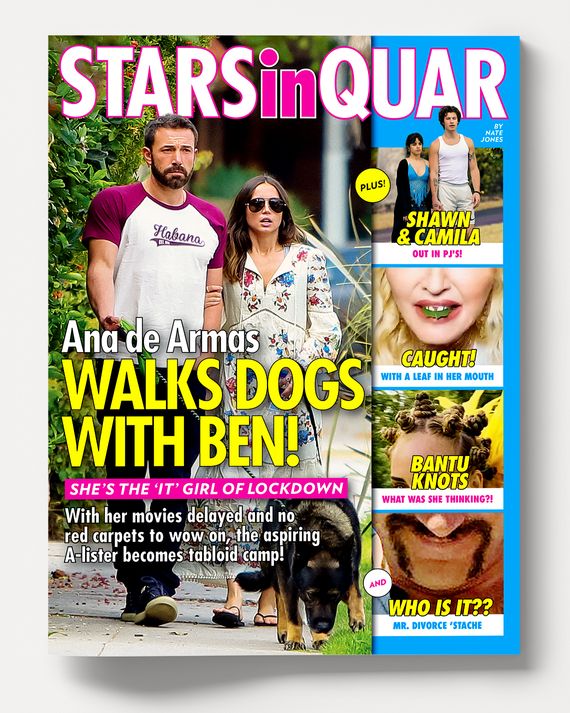
So mostly the happy couple took walks.
This was celebrity culture stripped to its bare essentials two attractive people performing the most basic human functions.
Their tabloid omnipresence lent a strange cast to de Armass burgeoning stardom.
Now she was getting the punch in of coverage usually reserved for Real Housewives.
), eventually, they began to play with it.
But if they were trying to be self-aware, their choices only further cemented their place as gossip-page fixtures.
Afflecks penchant for sporting T-shirts with Cuban slang recalled Tom Hiddlestons infamous I T.S.
By summers end, de Armas had done something few could boast: She had used quarantine successfully.
To ingest any celebrity coverage was to be confronted with her face over and over.
Still, something was missing.
She was a tabloid face with a hole at the center of her celebrity.
There is a placewhere stardom is shaped during the pandemic; its just not in the real world.
Social media has enabled stars to take back control of their images from the paparazzi and gossip sites.
The stars were using social media but had lost control of how their narratives were shaped.
De Armas never teetered that close to cancellation; her Instagram presence was careful not to reveal too much.
But her narrative was still open to being shaped by other authors.
(Its thrilling secrets include the speed setting at which Harry Styles runs on a treadmill.)
Where did this leave Ana de Armas?
It wasnt a stretch to imagine she was in on the joke.
